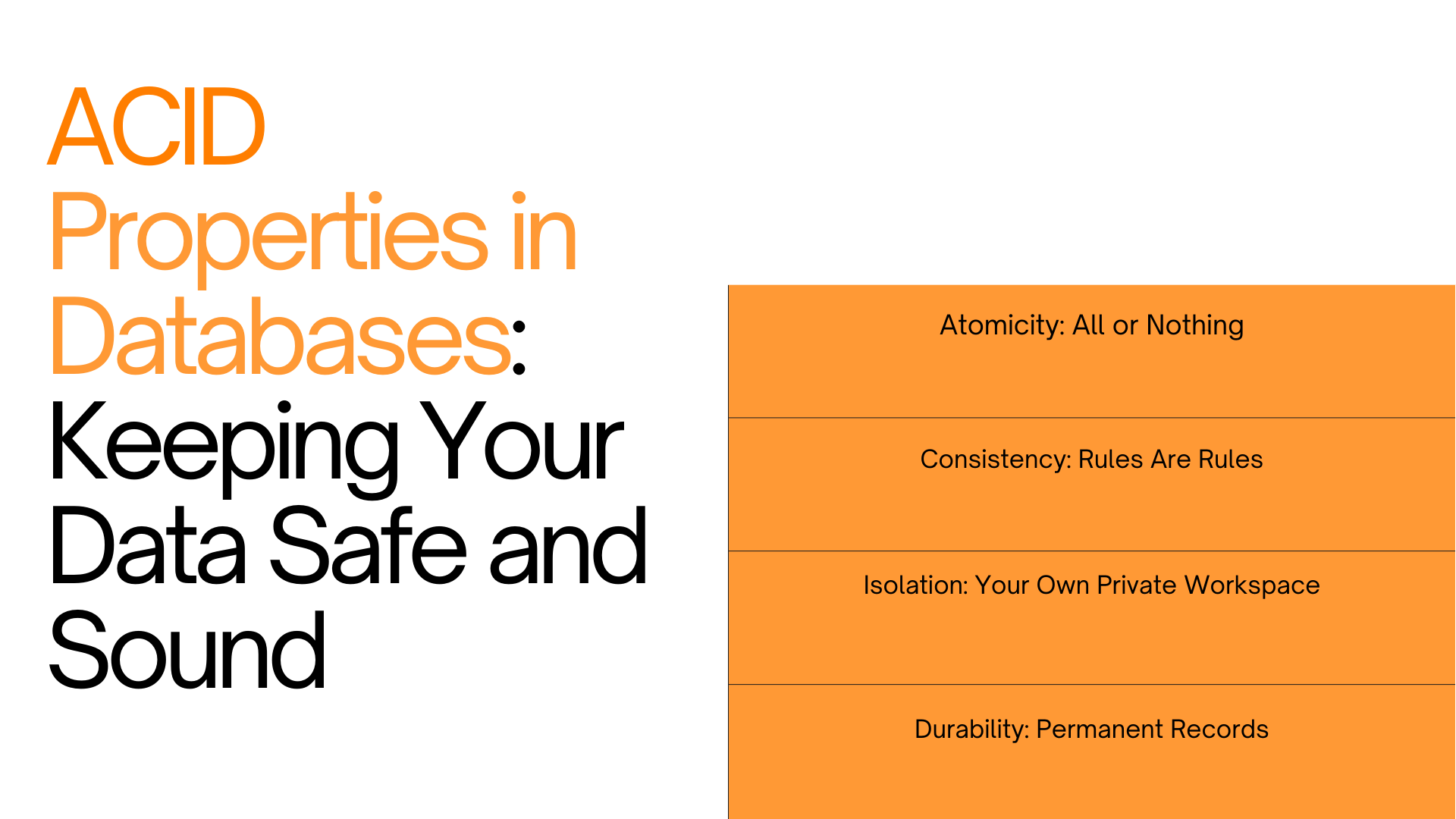
Have you ever transferred money between bank accounts and wondered how the system makes sure your dollars don’t vanish or duplicate? That’s where ACID comes in. ACID is a set of four simple rules that databases follow to keep your data accurate, reliable, and crash‑proof. Let’s walk through each one—and why they matter—using everyday analogies and plain English.
Atomicity: All or Nothing
Imagine you’re sending a birthday gift with two parts: a card and a present. You wouldn’t want the card to arrive without the gift, or vice versa. Atomicity makes sure that a database transaction behaves the same way: it either completes every step successfully, or it doesn’t happen at all. If something goes wrong—say a power blip—the database rolls back to how things looked before you started. That way, you never get half‑sent gifts or half‑written records.
Consistency: Rules Are Rules
Think of a game where every move must keep you on legal squares. You can’t suddenly hop to a forbidden spot. In database land, consistency means that every transaction moves the database from one valid state to another. If you try to break a rule—like withdrawing more money than you actually have—the database simply won’t allow it. This keeps your data trustworthy and prevents strange anomalies from creeping in.
Isolation: Your Own Private Workspace
Picture a busy kitchen at lunchtime with several chefs preparing different orders. You wouldn’t want Chef A’s soup to taste like Chef B’s sauce. Isolation ensures that each transaction in the database runs in its own “kitchen,” invisible to the others, until it’s completely done. Only when your transaction finishes does the rest of the world see its results. This prevents messy overlaps, like two people trying to buy the last concert ticket at exactly the same moment.
Durability: Permanent Records
Finally, durability is the promise that once a transaction is confirmed, it sticks—no matter what happens next. It’s like adding your signature in permanent ink: even if the power goes out or the server crashes, your change remains safely written in the database. When you hit “Save,” you can trust that your data survived the trip into storage.
Why ACID Matters for You
- Peace of Mind: You don’t have to worry about half‑completed transfers or missing data.
- Data Integrity: Your rules—whether they’re bank balances or inventory counts—always stay intact.
- Smooth Collaboration: Multiple users or applications can work at the same time without stepping on each other’s toes.
- Reliability: System failures (like crashes or network hiccups) won’t leave you in the lurch.
Conclusion
ACID might sound like a mouthful, but at its heart it’s all about keeping your data safe, consistent, and predictable—just like a good recipe makes sure your soup always tastes right. Next time you save a document, check out, or book a flight online, you can thank ACID for quietly working behind the scenes to make it all happen without a hitch.